
Pressure Point: A Digital Actor Showcase
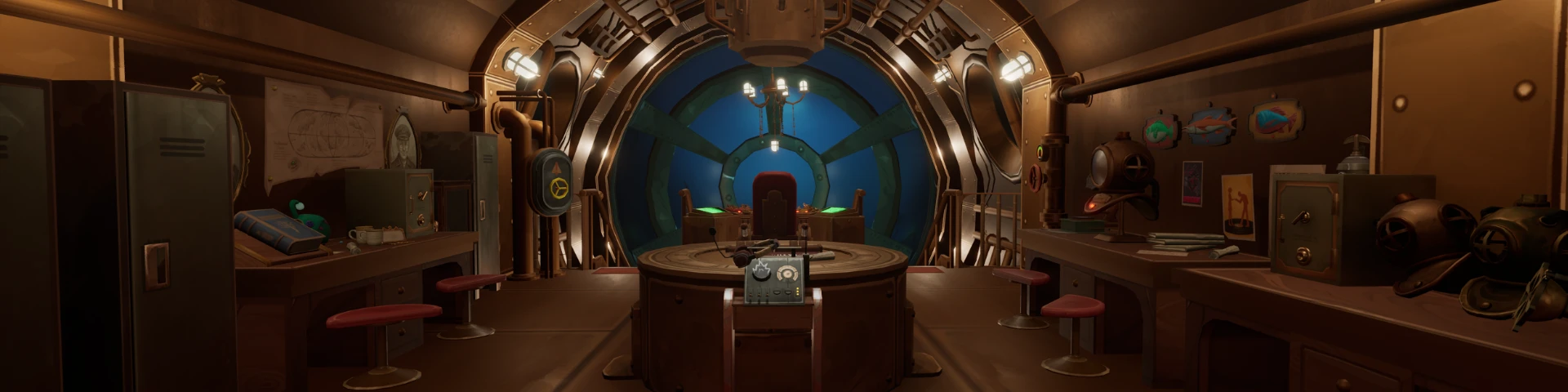 Click to play the demo before reading!
Towards a New Medium of Interactive Storytelling
At Iconic we are a team of AI researchers and game-makers with decades of combined experience, assembled around a single belief: the next great medium of entertainment won't be stories you watch, it will be stories you live.
The key enabler of this medium is the Digital Actor: an AI performer built from the work of a writer, a creative director, and a human actor. It performs the way an improv artist would, holding character, reading the player, shaping the scene as it unfolds. And where a human can perform live for one audience at a time, a Digital Actor streams that craft to every player at once, each meeting a performance made for them alone and faithful to the story and the creative direction behind it.
Pressure Point is the first public showcase of Iconic's Digital Actor technology: a short, linear scene in which you spend a few minutes alone on the bridge of a failing submarine, speaking over the radio with James, an officer who must be talked through an impossible decision. The path is set; how you act is not. Whatever you say, James answers in character, and the scene still moves through its narrative beats to the ending its writers intended.
I think this was a really impressive demo, and it was the first time I really enjoyed interacting with an LLM-driven NPC. I am surprised that this was all possible with local models, something that is of course crucial for this type of technology to actually be deployed in games. Other demos I've seen needed to do the round-trip to some datacenter, which introduces lag and is not economically feasible. I had a great time trying to understand and convince James. Even the voice "acting" was good (especially compared to other generative AI NPC demos I've seen). Surprisingly, James seemed to understand everything I said, and it felt like I could actually affect his thinking, while enjoying a well-crafted narrative.
Keeping a dynamic character strictly within the guardrails of a human-authored story, while leveraging the power of Gemma 4 to maintain the conversational fluidity and emotional nuance of a trained improv actor, is a massive technical and design challenge.
But impressive technology isn't enough; is it fun? That's what actually matters.
Creating digital actors that respect a writer's intent while giving players unprecedented agency is going to be a foundational pillar for a new generation of interactive entertainment. Congratulations to the team at Iconic for pioneering this space.
The natural-language conversation was really good. What stood out is that I could explore around the writing and have a real conversation in the space we were walking through together, rather than being dropped in front of an NPC and told to "go ahead and talk to it." About 99% of these demos fail at exactly that, whereas Iconic actually brought me in and gave me something to talk about. I'm someone who normally finds talking to an NPC out loud awkward, and here I didn't; it felt natural and easy. The character's ability to reason from very little information was better than I expected. Constraining everything to a single small space is a clever way to control the experience, and setting it beneath the ocean cleverly hides latency, since a slight delay feels right when sound has to travel through water. The only hiccups came from my own machine rather than the model, and being able to mess with the system was genuinely fun.
I watched several people interacting with the Digital Actor and I was impressed by its fast and game-relevant response but also its capacity to stick to the game narrative despite the serious efforts of players to break it. Speech to text works remarkably well and gameplay feels adaptive while being very well controlled. It is a great demonstrator of what AI technology can offer to push game development to the next level of personalization, both realistically and practically. The AI and games Summer School participants were impressed by the live demo delivered by [Iconic], arguably one of the best presentations delivered in the school.
The interaction is very naturalistic. It feels like an escape room essentially, with a single location. I really like the interaction that you have with a player by voice, because it feels very natural and controllable. It gives a different embodiment and a different interpretation to this automaton, that is kind of losing its humanity behind the mechanism: the glitch is not in the voice, the glitch is in the thinking. And that is quite fascinating, and fun to explore, and a bit unsettling. Very nice! The fact that you have to press a button to speak [...] is better for privacy: [...] it only records you when you speak. You can speak and do other things at the same time: that allows new forms of interaction. It's pretty amazing that it's so quick and so fast and live!
Creative perspective
This is the dream I've been chasing for some time: each and every player becomes the star of our stories. They talk to a Digital Actor in their own words, and what comes back is built for them alone, so every playthrough becomes something personal, rather than the same script played back. It's changed the job. Dialogue stops being something we author line by line; instead, we spend time on a persona and a narrative blueprint deep enough that the actor can hold the shape of the story while answering each player specifically, always in character. It's fascinating interacting with these personas, how they express themselves, verbally and emotionally, in ways that were never scripted but always recognisable. Pressure Point is the first experience we have made this way, and I cannot wait to show where we take it next.
— Martin Connor, Creative Director
Building a Digital Actor
Digital Actors are built on a framework we call directed open-endedness. Two human-authored inputs drive every performance: a persona blueprint, which defines who the character is, and a narrative blueprint, which defines the dramatic beats the scene must reach, with no scripted lines. How much of the journey those beats pin down is the director's choice; the framework spans everything from a fully authored path to scenes the actor navigates freely toward a dramatic goal. Pressure Point sits deliberately at the directed end. Every step of the journey is authored, and the actor's freedom lives entirely in the performance: how James listens, reacts, and improvises his way to each beat, whatever the player says.
Under the hood, a Digital Actor runs as a cascade of three models. An automatic speech recognition (ASR) model transcribes the player's speech; a large language model (LLM) decides how the scene should pivot and crafts the next performance beat, holding it faithful to both the persona and the narrative blueprint; and a text-to-speech (TTS) model turns that beat into voice, keeping the delivery just as true to the character. We chose a cascade for this generation of Digital Actors: separating the system into distinct stages gives us detailed control over each, lets our research and creative teams iterate in parallel, and makes the pipeline easier to debug in production.
Director: defines the journey up-front, human-authored
conditions the actor at every beat
Digital Actor: a cascade of three models, in real time
The LLM Orchestrator
Given the human-authored blueprints, a custom orchestration system directs the LLM turn by turn. The system ensures strong creative control, allowing the LLM to focus on what the actor does next and how it says it, with special attention to four dimensions:
Engaging with the player
A performance made for one player has to run on what that player actually says. The actor picks up the details players offer and folds them back into the scene.
Staying in character
The LLM keeps the actor inside the bounds of its persona and the narrative context: what James will talk about, what he won't, and how he deflects what doesn't belong in the scene.
Steering the narrative
Whatever the player does, the actor has to reach the beats of the narrative blueprint: handling misleading statements from the player and staging them to act on the environment.
Breathing life into characters
Standard LLMs are trained on written text, not spoken dialogue. Their responses come out verbose, polished, and clinical: fine on a screen, wrong the moment they're spoken aloud. Real speech is messy. We optimized our generation for exactly that, crafting each beat the way it should be performed, not read, down to the emotional markup the voice will render.
LLM "I understand your concern. Can you turn that valve for me?"
Digital Actor "Look... I— I can't... *sigh*... just turn the valve, okay?!"
The Voice: Contextual Text-to-Speech (CTTS)
To bring James to life, we built a custom, on-device CTTS model optimized for real-time dramatic performance, with a footprint small enough to run seamlessly alongside Unreal Engine and a Small Language Model (SLM) on standard consumer hardware.
Key features of our CTTS model
Creative co-design. Our AI team collaborates with our creative director and writers to map the character's persona. Voice actors record specific emotional ranges and subtexts — not random utterances — allowing the CTTS to replicate nuanced human performances on the fly.
Real-time contextual control. The LLM understands the dramatic context and generates emotional markup tokens. Our CTTS engine parses these tokens instantly to modulate pitch, timbre, intensity, and pacing.
Speech markers & paralinguistics. By tailoring text generation directly for our downstream TTS pipeline, we natively render breaths, self-corrections, pauses, and filler words to simulate real human conversation.
Persistent emotional states. Unlike single-delivery TTS engines, our system constructs overarching psychological states, maintaining emotional consistency across a scene while dynamically adapting to narrative shifts.
Examples of our CTTS in evolving context
James greets the player
"Hello?"
"Oh, finally someone answered! I'm James Kovich, retired lieutenant and crisis officer. Please, call me James."
James instructs the player during an emergency
"I'm sure no one is there."
"Right, but I need a confirmed reading. Go downstairs and check the occupancy machine by the machinery bay door."
James after effectively sacrificing his son to save the crew
"What do we do James?"
"Get to the bridge. Find the flood override lever. I'll be damned if his sacrifice is for nothing."
James says goodbye after the unfortunate adventure
"Sure."
"Right. Well, when Alex was small, and I was shipping out to sea, we had a special goodbye. 'Goodbye, I love you, I'm only a tide away.' I suppose now, he's finally reached that tide."
Making It Run Fast & Smooth
Immersive, emotional conversations require low and consistent latency without sacrificing quality. We've consistently found that the same experience feels much better for players when latency is minimised, and so this forms a core pillar of our work at Iconic. The most important metric is speech-to-speech latency — how many milliseconds between the player finishing their speech and hearing an actual response from the Digital Actor.
In the live version of Pressure Point, we see median speech-to-speech latencies of 1200ms, with 100ms spent to transcribe the player's speech and emotions, 700ms for the LLM to craft a response and update game state, and 300ms for TTS. Our experiential target is to bring this below one second, and we already see this running the demo internally.
To achieve this, we need to control the entire inference stack rather than calling out to any external models. We customise inference engines such as vLLM for our models, and our scheduler moves as many LLM calls as possible out of the critical path (while no-one is speaking), so that the Digital Actor can instantly respond when spoken to. We also allow interruptions and follow-ups from the player or Digital Actor.
All the models run on a single GPU that can be geo-located near users to minimise network latency and cost, or moved entirely on-device for future experiences.
To bring the Pressure Point experience straight into your browser at a button's press, we also take advantage of pixel streaming technology. The game runs on a GPU in AWS and is streamed to your browser, with inputs and microphone streamed back, whatever device you are on and wherever you are.
Your Turn
Play the tech demo for yourself, for a limited time, on Iconic Labs. We strongly recommend playing on a desktop or laptop with keyboard, mouse and microphone, plus speakers or a headset for the best experience.
We'd love to hear your feedback on the demo - drop us a line after you play!Next Steps
Pressure Point is a first step. It is a mostly linear scene, carried by one
persona and the weight of a single impossible choice, and within those
bounds a Digital Actor already makes the experience personal to whoever is
on the other end of the radio. We are excited about what comes next: more
open-ended experiences where the director doesn't need to dictate the
journey, embodiment beyond the voice, and theatrical performance of even
greater nuance.
If you're interested in learning more about Iconic or building together, get in touch.
— Iconic Team
* Quotes reflect the personal opinions and remarks of the individuals named and do not represent the views of their employers or affiliated organisations.